

Why Choose an Oil Rubber Hose for Industrial Applications?
Industrial fluid transfer is becoming more demanding. Oil, fuel, and hydraulic fluids can attack poorly selected hose compounds. High pressure adds another risk. Heat, vibration, abrasion, and repeated bending also shorten service life. An Oil Rubber Hose is designed to manage these conditions through reinforced layers and oil-resistant rubber compounds. It can support cleaner routing around pumps, tanks, compressors, and mobile equipment.
Market evidence supports this need. Grand View Research reported that the global industrial hose market was valued at approximately USD 14 billion in 2023. Its analysis also forecasts steady growth through 2030, driven by energy, manufacturing, mining, and chemical processing. The Freedonia Group’s industrial hose studies similarly identify replacement demand as a major market factor. That detail matters. Hoses do not last forever.
Rubber technology specialist John S. Dick states, “A rubber compound must be selected for the service environment.” This principle explains why appearance alone cannot guide purchasing decisions. A suitable Oil Rubber Hose should match fluid compatibility, working pressure, temperature range, bend radius, and required safety factor. Standards such as SAE J517, ISO 18752, and EN 1765 can strengthen specification and inspection practices. However, compliance does not remove the need for field judgment. Real installations may include sharp edges, pressure surges, or unexpected heat. Sometimes, the catalog choice looks correct but fails in service. Careful application review remains essential.
What Is an Oil Rubber Hose?
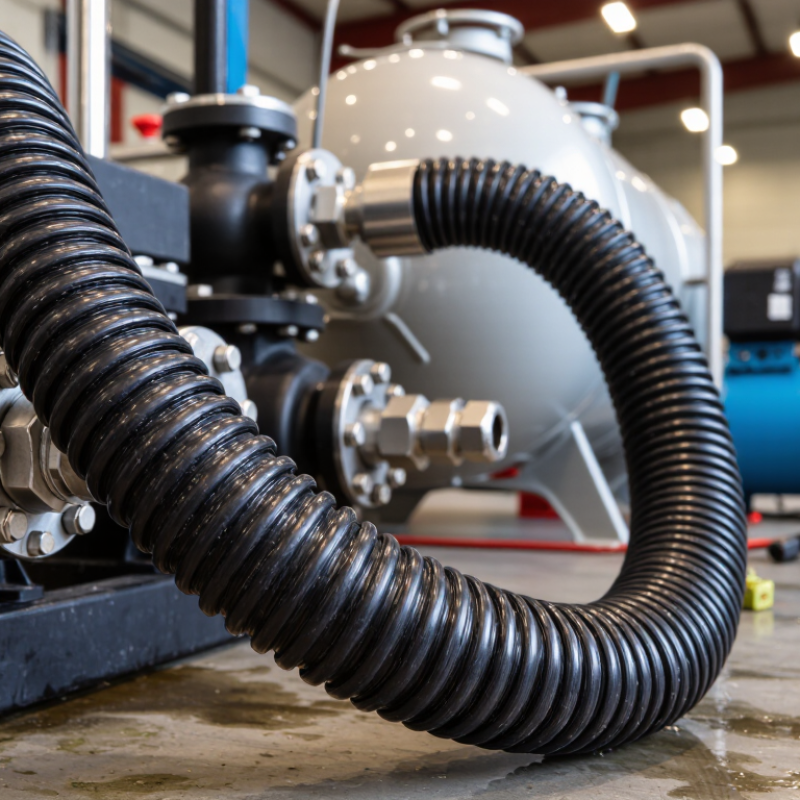
An oil rubber hose is a flexible, layered conduit designed to transfer petroleum-based fluids safely. Its inner tube uses oil-resistant elastomers, commonly nitrile rubber, to reduce swelling and softening. Textile or steel reinforcement provides pressure strength. The outer cover protects against abrasion, heat, moisture, and sunlight. This layered structure makes the hose useful in hydraulic systems, fuel transfer, compressors, and industrial machinery. However, oil resistance is not universal. A hose suitable for cool hydraulic oil may fail with hot fuel or aromatic solvents.
Industry demand reflects this broad use. Grand View Research’s Industrial Hose Market report estimated the global market at about USD 13.3 billion in 2023. It also projected continued growth through 2030. I would not treat that forecast as a design rule. Actual hose life depends on pressure cycles, temperature, fluid chemistry, bending radius, and storage. ISO 18752 provides performance classifications for rubber hoses. SAE J517 defines requirements for several hydraulic hose types. These standards support better selection, but they cannot replace checking the manufacturer’s compatibility chart.
Tips: Confirm the fluid, pressure, temperature, and inner diameter before ordering. Inspect for cracks, blisters, exposed reinforcement, and permanent kinks. Replace doubtful hoses early. A cheaper hose can become expensive after one unnoticed leak. Also, avoid forcing a hose below its stated bend radius. That common shortcut deserves more reflection.
Why Choose an Oil Rubber Hose for Industrial Applications?
Oil-resistant rubber hoses are commonly selected for hydraulic oil, lubricating oil, diesel, and other petroleum-based fluids because their elastomer compounds help reduce swelling, hardening, and leakage. NBR is widely used for general oil service, while FKM supports higher continuous temperatures. Actual performance depends on hose construction, pressure, fluid concentration, and operating conditions.
How Oil Rubber Hoses Are Designed for Industrial Use
Why Choose an Oil Rubber Hose for Industrial Applications?
How Oil Rubber Hoses Are Designed for Industrial Use
Oil rubber hoses are engineered as layered systems, not simple tubes. The inner tube usually uses oil-resistant rubber, such as nitrile-based compounds. Textile or wire reinforcement controls pressure and limits expansion. A protective outer cover resists abrasion, heat, ozone, and workplace chemicals. Small details matter. The wrong compound can soften quickly in diesel, hydraulic oil, or lubricating fluids.
MarketsandMarkets’ 2024 Industrial Hose Market report projects the sector to grow from about USD 13.9 billion in 2024 to USD 17.7 billion by 2029. This demand reflects stricter performance needs across machinery, transport, and processing facilities. Engineers must check working pressure, temperature range, fluid compatibility, and minimum bend radius. ISO 18752 classifications also help compare pressure performance and impulse resistance. A hose that fits visually may still fail operationally.
In field maintenance, coupling quality often matters as much as rubber selection. Assemblies should be pressure-tested, supported near connection points, and inspected for blisters, cracks, exposed reinforcement, and permanent swelling. Oil changes that equation. Static electricity, heat near engines, and repeated flexing can accelerate damage. The U.S. Occupational Safety and Health Administration recommends controlling stored energy and inspecting equipment before use. Yet inspection intervals are not always realistic in dusty plants. That weakness deserves honest review, because even a well-designed hose depends on installation and daily handling.
Key Performance Benefits in Oil-Handling Applications
Why Choose an Oil Rubber Hose for Industrial Applications?
Key Performance Benefits in Oil-Handling Applications
Oil-handling work punishes weak hose design. During field inspections, I check compatibility, pressure rating, and bend radius. An oil rubber hose uses layered construction for demanding transfer conditions. The inner tube resists the handled fluid, while reinforcement controls expansion under pressure. The outer cover faces abrasion, sunlight, moisture, and oily surfaces. This separation is practical, not decorative.
Flexibility is a major advantage around pumps, drums, and mobile equipment. A hose can follow changing connections without forcing rigid pipework. That reduces installation strain at couplings. Flexibility also helps workers position a nozzle safely and neatly. Pressure stability matters during filling and draining. Reinforcement limits swelling, supporting predictable flow and reducing sudden movement. Some designs tolerate elevated temperatures, but resistance varies widely. Check the data.
Durability depends on more than rubber quality. I have seen new hoses fail early after tight bends, dirty couplings, or skipped inspections. Operators should confirm fluid type, working pressure, temperature, electrical requirements, and minimum bend radius before installation. Inspect for blisters, cuts, soft spots, exposed reinforcement, and damaged fittings. Replace questionable assemblies. A small leak can contaminate equipment and create a slippery work area. An oil rubber hose is not automatically suitable for every oil.
How to Select the Right Oil Rubber Hose
Why Choose an Oil Rubber Hose for Industrial Applications?
How to Select the Right Oil Rubber Hose
Selecting an oil rubber hose starts with the fluid, not the hose appearance. Check the oil type, temperature, pressure, and operating frequency. Mineral oil, hydraulic fluid, and synthetic oil may affect rubber differently. Nitrile rubber suits many petroleum-based oils. Fluoroelastomer can perform better under higher heat and chemical exposure. Always confirm compatibility through technical data.
Pressure ratings need careful attention. Identify both working pressure and surge pressure. A hose should not operate continuously at its maximum rating. Measure the inner diameter to protect flow and reduce pressure loss. Then check the bend radius, fitting design, and connection method. A hose that bends sharply near a fitting may fail early. It can look fine outside.
Field inspections often reveal simple mistakes. Oil residue near a coupling may indicate leakage, vibration, or poor assembly. Check for swelling, cracks, stiffness, and surface softening. Temperature also matters; heat from nearby equipment can exceed the fluid temperature. Use protective sleeves where abrasion is likely. I would not select a hose from price alone. It is easy to overlook storage age, reinforcement quality, or certification requirements. Ask for documented test results and installation guidance. Then compare them with the equipment’s actual working conditions, not ideal workshop conditions.
Maintenance and Safety Considerations for Long-Term Use
Why Choose an Oil Rubber Hose for Industrial Applications?
An oil rubber hose handles flexible routing around pumps, tanks, and moving equipment. Its layered construction can resist oil exposure, vibration, and moderate abrasion. However, long service life depends more on maintenance than appearance. A hose may look clean while its inner tube is already weakening. Check the hose before every shift for swelling, cracks, flattened sections, and exposed reinforcement. Pay special attention to fittings. Small leaks often begin there. Confirm that the hose rating matches the oil type, operating pressure, temperature, and bending radius. Never rely on a higher pressure rating alone. Chemical compatibility still matters.
Tips: Keep hoses away from sharp edges, hot surfaces, and unnecessary twisting. Use proper supports instead of tight clamps. Replace a hose after severe impact, even without visible damage. During storage, cap both ends and keep the hose away from sunlight, moisture, and ozone-producing equipment. Do not drag it across concrete. That habit is convenient, but costly.
Safety improves when inspections are recorded with dates, pressure conditions, and observed defects. Maintenance teams should depressurize the system before loosening any connection. Oil injection injuries can appear minor while requiring urgent medical attention. Train workers to report leaks immediately, not after production stops. In my experience, scheduled replacement is sometimes chosen too early. Yet delaying replacement is a worse gamble. Review inspection records and actual operating conditions together. Guesswork has no place near pressurized oil.
Why Choose an Oil Rubber Hose for Industrial Applications? - Maintenance and Safety Considerations for Long-Term Use
| Data Dimension | Typical Information | Maintenance or Safety Relevance |
|---|---|---|
| Primary application | Transfer of petroleum-based oils, lubricants, hydraulic fluids, and selected fuel products, subject to hose-material compatibility. | The hose must be selected for the exact fluid, concentration, pressure, temperature, and operating environment. |
| Common construction | Oil-resistant elastomeric inner tube, textile or wire reinforcement, and an abrasion-, weather-, or oil-resistant outer cover. | Each layer performs a different function; damage to the cover can expose reinforcement and accelerate hose failure. |
| Pressure selection | Select a hose whose rated working pressure exceeds the system's maximum operating pressure, including foreseeable surges. | Never use working pressure as a substitute for burst pressure. Pressure ratings depend on temperature, assembly, fittings, and application. |
| Temperature range | Many industrial oil hoses are designed for approximately -40°C to +100°C, but the permitted range varies by compound and fluid. | Excessive heat accelerates aging, while low temperatures can reduce flexibility and increase bending stress. Always verify the product specification. |
| Flexibility and routing | Rubber hoses generally tolerate vibration and movement better than rigid piping when correctly sized and routed. | Maintain the specified minimum bend radius and avoid twisting, sharp bends, crushing, and contact with hot surfaces or moving parts. |
| Chemical compatibility | Compatibility depends on the oil type, additives, aromatic content, temperature, exposure time, and inner-tube compound. | Incompatible fluids may cause swelling, softening, hardening, cracking, or loss of reinforcement adhesion. |
| Visual inspection frequency | Inspect before use and during scheduled maintenance; high-risk or high-pressure systems may require more frequent checks. | Look for blistering, cuts, abrasion, exposed reinforcement, flattened sections, kinks, leakage, corrosion at fittings, and cover cracking. |
| Leak detection | Check for wetness, oil mist, drops, odor, pressure loss, or visible fluid tracking around fittings and hose surfaces. | Do not locate a pressurized leak with bare hands. Depressurize the system and use suitable inspection methods and personal protective equipment. |
| Fitting and assembly practice | Use compatible fittings, correct insertion depth, proper crimping or coupling procedures, and clean hose ends. | Improper assembly is a major source of leakage and separation. Do not mix components unless compatibility is confirmed. |
| Contamination control | Keep hose interiors capped, clean, and free from moisture, dust, metal particles, and residual chemicals during storage and installation. | Internal contamination can damage pumps, valves, seals, and other precision components in hydraulic or lubrication systems. |
| Storage conditions | Store in a cool, dry, ventilated area away from direct sunlight, ozone sources, heat, solvents, oils, and sharp edges. | Avoid prolonged compression, stretching, tight coiling, and contact with electrical equipment that can generate ozone. |
| Replacement indicators | Replace immediately when there is reinforcement exposure, deep abrasion, severe cracking, a permanent deformation, fitting damage, or recurring leakage. | A hose may fail internally before external damage is obvious; replacement decisions should follow inspection results and the equipment risk assessment. |
| Service-life planning | There is no universal service-life period. Life depends on pressure cycles, temperature, fluid, movement, routing, storage, and maintenance quality. | Use inspection records, operating history, and applicable hose standards or manufacturer guidance to establish a replacement program. |
| Safety documentation | Maintain records of hose identification, installation date, fluid service, pressure rating, inspection findings, and replacement date. | Traceable records support preventive maintenance, regulatory compliance, safer troubleshooting, and consistent replacement decisions. |
Note: Performance ratings and inspection intervals vary by hose construction and operating conditions. Confirm all selections and procedures against the applicable technical specification, safety standard, and equipment manufacturer's instructions.

