R&D Ergo new logo

ERGONOMIC SOLUTIONS FOR OVER 25 YEARS.

To serve you better | Now merging service and customer support with our sister company Liftsafe Engineering and Service Group.

Top Hot Extrusion Hydraulic Press Line Manufacturers?

The search for leading Hot Extrusion Hydraulic Press Line manufacturers requires more than comparing machine prices. It demands evidence of engineering depth, production reliability, and long-term service capability. A press may look impressive in a showroom. Its real performance appears during continuous billet heating, high-pressure extrusion, and repeated die changes.

Industry demand supports this investigation. The International Aluminium Institute reported global primary aluminium production above 70 million tonnes in 2023. That scale reflects strong pressure on manufacturers to improve forming efficiency, material recovery, and energy management. The U.S. Department of Energy also identifies aluminum production as an energy-intensive industrial process. Therefore, modern press lines should be judged by output stability, hydraulic efficiency, automation, and measurable downtime reduction.

Numbers matter.

Market research reports from MarketsandMarkets and Grand View Research indicate continued growth in hydraulic press and metal-forming equipment. However, their market boundaries differ. Some include general hydraulic presses, while others separate extrusion systems. Direct comparisons can become misleading. This guide therefore examines manufacturers through practical criteria, including press force, billet diameter, control architecture, safety systems, commissioning experience, spare-parts access, and verified customer applications.

A reliable supplier should explain technical limits clearly. It should provide load calculations, cycle-time data, maintenance schedules, and acceptance-test records. Factory visits can reveal details that brochures hide, such as oil cleanliness, welding quality, and operator training. Certifications help, but they do not replace field evidence. The final ranking should remain open to revision, because regional service quality and project complexity can change the result. That is the honest limitation.

Top Hot Extrusion Hydraulic Press Line Manufacturers?

What Is a Hot Extrusion Hydraulic Press Line?

A hot extrusion hydraulic press line is an integrated production system for shaping heated metal billets.

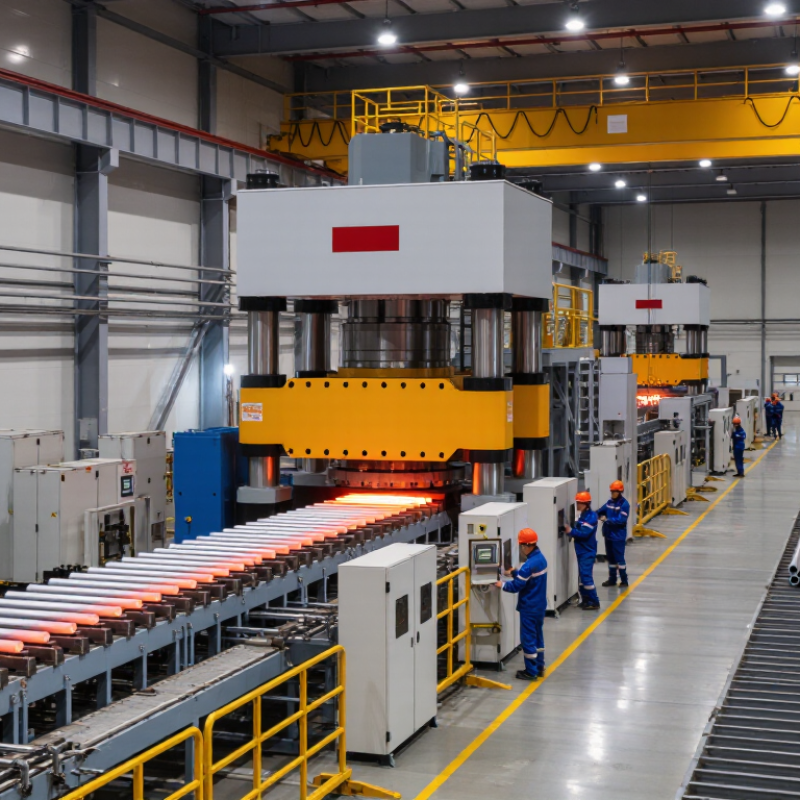
It heats a billet until the material becomes workable, but not fully liquid. The billet then enters a container and receives pressure from a hydraulic ram. Metal flows through a shaped die, creating profiles with consistent dimensions. Common outputs include tubes, channels, rods, and complex structural sections. Unlike a standalone press, the complete line coordinates heating, extrusion, cutting, cooling, and handling.

In practical plant work, operators monitor billet temperature, ram speed, pressure, and die condition. A few degrees can change surface quality. Excessive pressure may damage the die or reduce equipment life.

After extrusion, runout tables and cooling beds support straightness and controlled cooling. Accurate alignment matters. Even a small offset can produce uneven profiles. Maintenance teams inspect seals, pumps, hydraulic oil, guides, and electrical controls on a scheduled basis. Still, no line is perfect. Tool wear, material variation, and operator judgment can affect results. That part is sometimes underestimated.

When evaluating manufacturers, buyers should request verified capacity data, material compatibility, installation records, safety documentation, and service response details.

A reliable supplier should explain pressure calculations and energy use clearly. It should also provide training and spare-parts guidance. Claims without test records deserve careful review. Performance on paper may not match a demanding production floor.

How Does a Hot Extrusion Hydraulic Press Line Work?

How Does a Hot Extrusion Hydraulic Press Line Work?

A hot extrusion hydraulic press line converts a heated billet into a continuous profile. The process begins with billet heating, usually between 400°C and 500°C for many aluminum alloys. A shear or saw prepares the billet, then a hydraulic ram pushes it through a shaped die. Pressure can exceed 1,000 tonnes on large industrial presses. The container holds the billet, while the die controls the final cross-section. It is a forceful, carefully timed sequence.

400°C
500°C

After emerging, the profile travels across a runout table. Air or water cooling stabilizes its shape and mechanical properties. A puller maintains movement and reduces bending. The profile is then stretched, cut to length, and sometimes aged in a controlled furnace. Sensors monitor ram speed, billet temperature, pressure, and die alignment. Small temperature changes can create visible surface defects. That detail is easy to underestimate.

95%
less energy

Grand View Research estimated the global aluminum extrusion market at about USD 83 billion in 2023, reflecting strong demand for lightweight profiles. The International Aluminium Institute reports that recycled aluminum can require up to 95% less energy than primary aluminum. Therefore, billet composition and scrap control matter greatly. In practice, the process is not perfectly predictable. Die wear, uneven heating, and operator judgment still affect output. A reliable line needs data, maintenance discipline, and experienced adjustment, not hydraulic power alone.

Which Features Define High-Quality Press Line Manufacturers?

High-quality hot extrusion hydraulic press line manufacturers begin with engineering evidence, not attractive brochures. They should explain press capacity, extrusion speed, billet temperature, and expected output with measurable data. A reliable supplier also studies the alloy, profile shape, production volume, and available floor space before proposing equipment.

Proof matters. Ask for factory acceptance records, pressure tests, cycle-time reports, and sample profiles produced on comparable lines. Strong manufacturers use accurately machined cylinders, rigid frames, stable hydraulic systems, and responsive temperature controls. Their electrical cabinets should support clear diagnostics, safe shutdowns, and practical operator access. Small details matter, especially during a long production shift.

Experienced manufacturers provide installation guidance, operator training, spare-parts planning, and remote troubleshooting. Their engineers should discuss preventive maintenance intervals instead of promising effortless operation. They should also identify risks, such as oil contamination, uneven billet heating, or die alignment errors. No supplier gets every detail right. Honest technical communication is more useful than exaggerated perfection. Check whether drawings, manuals, inspection records, and performance guarantees match the actual machine. A dependable press line should leave a traceable record from design review to commissioning, while allowing sensible adjustments after real production begins.

Top Hot Extrusion Hydraulic Press Line Manufacturers

High-quality press line manufacturers are typically evaluated by their ability to deliver stable hydraulic performance, accurate extrusion control, safe operation, efficient thermal management, and dependable after-sales support.

The chart presents a practical 100-point procurement scorecard for comparing hot extrusion hydraulic press line suppliers. The criteria reflect common engineering, production, safety, and lifecycle requirements; weighting should be adjusted for the alloy, product size, production volume, and regional standards involved.

How to Compare Hot Extrusion Press Line Suppliers?

Comparing hot extrusion hydraulic press line suppliers requires more than checking press tonnage or a polished website. Start with production details: billet diameter, alloy range, target output, extrusion speed, and heating temperature. A capable supplier should explain how each specification affects the complete line.

Ask for evidence from similar installations. Request reference projects, commissioning records, acceptance-test procedures, and actual energy data. Review the hydraulic system, control cabinet, billet loader, die handling, cooling equipment, and safety interlocks as one system. Numbers can mislead. A larger press may increase costs without improving your products.

Technical support also separates experienced manufacturers from simple equipment sellers. Check response times, spare-parts availability, software access, operator training, and maintenance instructions. Confirm whether engineers supervise installation and production trials. Compare the total cost over ten years, not only the purchase price. That gap matters.

During supplier meetings, test their questions. Do they ask about your alloy, die life, workshop layout, and quality targets? If they offer a fixed design too quickly, be cautious. I have seen projects delayed because cooling capacity was estimated poorly. Even experienced teams make assumptions. A reliable supplier records risks, explains limits, and adjusts the proposal before contracts are signed. Pay attention to documentation quality; unclear drawings often become expensive production problems.

Top Hot Extrusion Hydraulic Press Line Manufacturers? - How to Compare Hot Extrusion Press Line Suppliers?

Use this supplier-comparison framework to evaluate hot extrusion hydraulic press lines without relying only on brand reputation or quoted press tonnage. The benchmark values below are general industry reference ranges and should be confirmed through technical documentation, acceptance tests, and customer references.

Evaluation Category Key Metric Industry Reference or Typical Requirement What to Compare and How to Verify Suggested Weight Important Note
Press Capacity Nominal pressing force Common hot extrusion hydraulic presses cover approximately 1,000 to 20,000 metric tonnes, depending on material, billet size, and product cross-section. Check the guaranteed working force, maximum force, return force, and continuous operating force. Confirm that the selected capacity is calculated from the actual alloy, billet diameter, extrusion ratio, and profile geometry. 15% Higher tonnage alone does not guarantee higher productivity or better product quality.
Product Compatibility Material and product range A suitable line should be configured for the target materials, such as aluminum, copper, brass, steel, titanium, or nickel-based alloys. Request a written compatibility matrix covering alloy grades, billet diameter, maximum extrusion ratio, profile dimensions, product length, and permitted temperature range. 12% A press optimized for aluminum may not be suitable for copper alloys or steel without major configuration changes.
Billet System Billet diameter and length Typical commercial systems use billet diameters selected according to the press size and product requirements; many lines are designed for billets from roughly 100 to 500 mm in diameter. Compare billet loader design, billet length tolerance, centering accuracy, transfer time, discard handling, and compatibility with the customer's existing billet furnace or saw. 8% Billet dimensions must be matched with container diameter, tooling, and heating capacity.
Heating Performance Billet heating temperature and uniformity The required temperature depends on the alloy. Aluminum extrusion billets are commonly heated to approximately 400–500°C; copper and steel require substantially higher process temperatures. Check furnace zoning, temperature-control accuracy, heating time, temperature uniformity, pyrometer arrangement, and the availability of recorded temperature data for each billet. 10% The correct temperature range must be established for the specific alloy and tooling combination.
Extrusion Speed Ram speed and production speed Hydraulic ram speeds vary widely. Typical systems may provide a controllable working speed from approximately 1 to 20 mm/s, while some applications require higher rapid-approach speeds. Compare rapid approach, working speed, piercing speed where applicable, speed stability, programmable speed profiles, and the supplier's guaranteed output for representative products. 10% Maximum speed is less important than stable speed control during the actual extrusion stroke.
Productivity Cycle time and output Actual output depends on billet preparation, heating, extrusion ratio, product length, tool changes, cooling, cutting, and handling. Compare complete line cycle time rather than press cycle time alone. Request a production simulation or acceptance-test calculation including billets per hour, kilograms per hour, scrap rate, die-change time, and planned maintenance stoppages. 12% Ask suppliers to use the same product specification when comparing output figures.
Hydraulic System Pressure stability and efficiency A modern system should provide stable pressure control, overload protection, filtration, cooling, and hydraulic components sized for continuous duty. Review pump type, pressure rating, oil filtration level, tank capacity, oil-cooling method, leakage protection, pressure-holding performance, and maintenance intervals. 8% Hydraulic efficiency affects energy consumption, oil temperature, noise, and long-term reliability.
Automation Control and data logging A complete line normally includes PLC-based control, HMI operation, recipe management, alarm history, process monitoring, and interfaces for auxiliary equipment. Confirm PLC and drive specifications, remote diagnostics, user-access levels, data export, recipe backup, communication protocols, and cybersecurity requirements. 8% The control platform should be supportable in the buyer's region for the expected service life.
Tooling and Changeover Container, die, and tooling system The line should accommodate the required container diameter, die stack, dummy block, stem, discard system, and die-change method. Compare tool-change time, die preheating, container cleaning, dummy block changeover, alignment adjustment, tooling life, and availability of standard spare tooling. 7% Tooling compatibility has a direct effect on downtime and product consistency.
Safety Machine safeguarding The line should include guarding, interlocked doors, emergency stops, safe hydraulic states, thermal protection, pressure relief, and controlled access to hazardous zones. Request the risk assessment, safety-circuit description, safeguarding layout, emergency-stop response, safety validation documents, and applicable conformity certificates. 8% Safety requirements vary by installation location and applicable legislation.
Energy and Utilities Specific energy and utility demand Compare total line consumption, including hydraulic power, billet heating, cooling, compressed air, and auxiliary equipment. Do not compare motor power alone. Request connected load, average operating load, estimated kilowatt-hours per tonne, cooling-water flow, compressed-air consumption, and energy-saving operating modes. 5% Measured consumption should be verified during a production acceptance test.
Quality Assurance Dimensional and surface consistency Quality performance should be evaluated against the customer's product tolerances, surface-finish requirements, mechanical properties, and applicable material standards. Review sample products, dimensional inspection records, process repeatability, temperature records, pressure curves, and the proposed factory-acceptance-test procedure. 10% Require measurable acceptance criteria instead of general statements about quality.
Service and Parts Support response and spare-parts availability A credible supplier should provide commissioning, operator training, preventive-maintenance instructions, troubleshooting support, and a defined spare-parts strategy. Compare warranty duration, response time, local technicians, remote-support capability, recommended critical spares, parts lead times, and service pricing. 10% Long-term support can be more important than a small difference in initial purchase price.
Commercial Evaluation Total cost of ownership Evaluate purchase price together with installation, commissioning, tooling, utilities, energy, maintenance, spare parts, downtime, and expected service life. Use the same scope of supply for every quotation and separate included items, optional items, exclusions, taxes, transportation, installation, and training costs. 10% The lowest initial quotation may have a higher lifecycle cost.
Supplier Due Diligence Relevant project experience The strongest evidence is successful delivery of comparable press capacity, material type, product geometry, automation level, and production volume. Ask for anonymized reference projects, operating years, delivered line configuration, performance results, customer-reported availability, and permission to conduct reference checks. 10% Compare demonstrated results, not only catalog specifications.
Scoring Method Weighted supplier score Score each criterion from 1 to 5: 1 = unacceptable, 3 = meets the requirement, and 5 = clearly exceeds the requirement. Calculate: Weighted Score = Criterion Score ÷ 5 × Criterion Weight. Shortlist suppliers only after technical compliance, safety, and total-cost checks. 100% A supplier should not compensate for a failed mandatory requirement with high scores in optional categories.

What Industries Use Hot Extrusion Hydraulic Press Lines?

Hot extrusion hydraulic press lines serve industries that need strong, accurate metal profiles. Automotive manufacturers use them for structural rails, suspension parts, heat sinks, and lightweight body components. Aluminum extrusion is common because it reduces vehicle weight without sacrificing stiffness. Copper extrusion also supports electrical connectors, busbars, and thermal components.

The aerospace sector uses these lines for aluminum and titanium parts requiring controlled dimensions and dependable material performance. Rail manufacturers produce window frames, interior supports, and carriage structures with similar equipment. Construction companies rely on extruded profiles for curtain walls, door frames, bridge components, and modular structures. Heat matters. Billet temperature, die design, and pressing speed must remain stable throughout production.

Energy industries use hot extrusion for copper conductors, aluminum transmission components, and selected parts in renewable power systems. Industrial machinery producers also extrude shafts, tubes, guides, and custom sections. A reliable line should provide pressure control, billet tracking, cooling management, and complete production records. These details help engineers investigate cracks, distortion, or uneven surface quality.

Not every application needs the largest press. A common planning mistake is choosing capacity before understanding alloy behavior and profile complexity. Even experienced teams can underestimate die wear or cooling delays. Small errors spread. Careful trials, dimensional inspections, and documented maintenance create more trustworthy results, although no production line removes every manufacturing risk.