

R&D Ergo new logo

ERGONOMIC SOLUTIONS FOR OVER 25 YEARS.

To serve you better | Now merging service and customer support with our sister company Liftsafe Engineering and Service Group.

How to Choose the Right Chemical Storage Cabinet?

Choosing the right Chemical Storage Cabinet is a risk-control decision, not a simple purchasing task. OSHA estimates that approximately 32 million workers handle hazardous chemicals across about 3 million American workplaces. Its Hazard Communication Standard also covers more than 650,000 chemical products. These figures reveal the scale of everyday chemical exposure. A small laboratory cabinet can still protect people, equipment, and business continuity.

The correct choice begins with chemical compatibility. Flammable liquids, corrosives, oxidizers, and toxic substances require different storage approaches. NFPA 30 offers recognized guidance for flammable and combustible liquid storage. OSHA’s chemical safety requirements emphasize labeling, hazard information, training, and controlled handling. FM Global property-loss guidance also highlights the importance of separating incompatible materials and managing ignition sources. A cabinet should match the chemical’s hazard class, container size, storage volume, and workplace conditions. Check the Safety Data Sheet before comparing models.

Details matter. Look for suitable construction, adjustable shelves, spill containment, self-closing doors, grounding options, and clear labeling. Ventilation should not be added automatically; it may create new risks or reduce fire protection if poorly designed. A cabinet may appear robust yet fail the real test: can staff identify the contents quickly during a spill? That question is sometimes overlooked. Selection also depends on local fire codes, insurance requirements, and the cabinet’s certification, not only its price. The safest decision combines manufacturer documentation, professional review, and regular inspection. No cabinet removes risk completely. It only manages risk when people use it correctly.
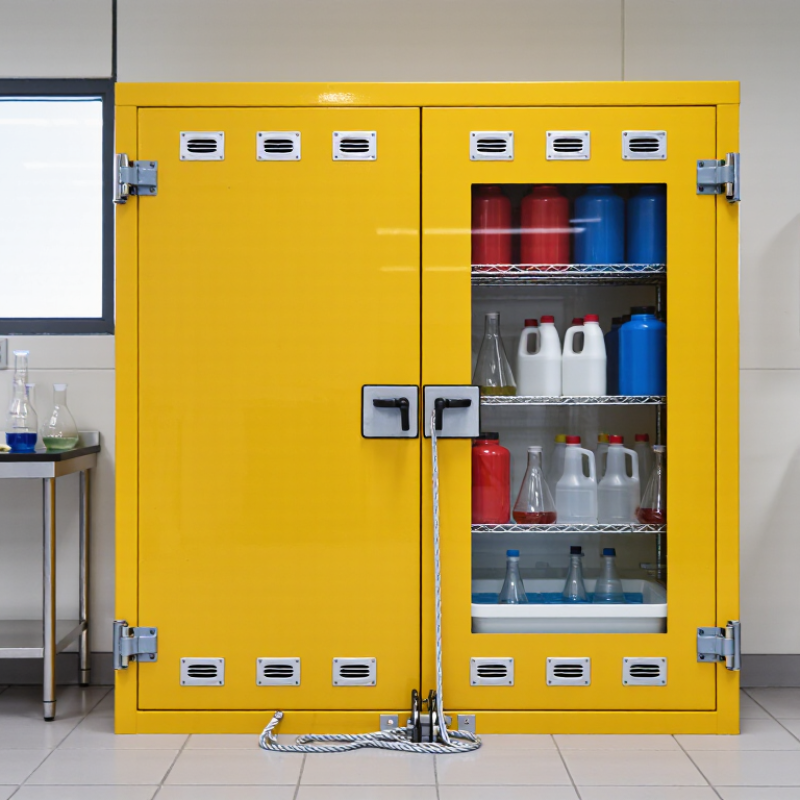
How to Choose the Right Chemical Storage Cabinet?

Classify Chemicals Using SDS, GHS Hazard Classes, and Compatibility Data

How to Choose the Right Chemical Storage Cabinet?

Classify Chemicals Using SDS, GHS Hazard Classes, and Compatibility Data

Choosing a chemical storage cabinet begins with classification, not appearance. Read the current Safety Data Sheet before measuring cabinet space. Sections 2, 7, and 10 provide essential information. Check hazards, handling instructions, storage conditions, and incompatibilities. Record the chemical name, concentration, physical state, and required temperature. Never rely on memory. SDS documents can become outdated, so verify their revision dates.

Use GHS hazard classes to identify risks such as flammability, corrosivity, oxidation, and acute toxicity. However, GHS labels alone cannot determine every storage decision. Compatibility data must guide placement. Keep acids away from bases. Separate oxidizers from organic solvents and reducing agents. Store water-reactive materials in dry, controlled areas. Check each mixture separately. Small details matter.

Create compatibility groups and match them with suitable cabinet compartments. Secondary containment can control leaks, but it cannot correct incompatible storage. Ensure shelves support the container weight and cabinet capacity. Avoid placing incompatible chemicals together, even when containers are sealed. Follow SDS instructions and applicable workplace requirements. Consult a qualified safety professional when information conflicts. A tidy cabinet can still be unsafe. Review the arrangement after formulation changes, new SDS documents, or spills. Document the reason for each storage decision. That record may expose a weak assumption later.

How to Choose the Right Chemical Storage Cabinet?

Classify chemicals using the Safety Data Sheet (SDS), GHS hazard classes, and compatibility data. The chart shows representative closed-cup flash points for common pure chemicals. Lower flash points indicate a greater need for flammable-liquid storage controls.

Under GHS criteria, flammable liquids are generally classified as Category 1 or 2 when the flash point is below 23°C, and Category 3 when the flash point is between 23°C and 60°C, subject to boiling-point rules. Always verify the exact flash point, GHS classification, incompatibilities, and storage recommendations in the current SDS. Keep flammables separate from oxidizers and segregate incompatible acids, bases, and reactive chemicals.

Match Cabinet Materials to Flammable, Corrosive, Toxic, and Reactive Hazards

How to Choose the Right Chemical Storage Cabinet?

Match the cabinet material to the hazard, not just the container size. For flammable liquids, a tested steel cabinet with self-closing doors provides durable protection and limits ignition exposure. Keep containers sealed, upright, and away from heat sources. Do not use the cabinet as a general storage closet.

Corrosive Chemicals

Corrosive chemicals need stronger material decisions. Acids can attack ordinary metal, while some bases damage coatings and hardware. Polyethylene or polypropylene cabinets often resist these chemicals better, but compatibility still depends on concentration and temperature. Store acids and bases separately. Small leaks can become serious.

Toxic and Reactive Materials

Toxic chemicals usually require secure, clearly labeled storage with surfaces that tolerate the specific substance. A locked steel or chemical-resistant cabinet may work, but the Safety Data Sheet should guide the choice. Reactive materials demand extra caution. Select specialized, non-combustible materials when required, and separate chemicals that react with water, oxidizers, acids, or organic substances.

Final Checks

Check the shelves, hinges, spill containment, and cabinet location. They matter too. A cabinet can look suitable

Verify Storage Capacity: NFPA 30 Permits Up to 120 Gallons per Cabinet

Choosing a chemical storage cabinet starts with capacity, but the number alone can mislead. NFPA 30 permits up to 120 gallons of Class I, II, and IIIA liquids in one approved cabinet under specified conditions. However, no more than 60 gallons may be Class I and Class II liquids. Always confirm the liquid classification from its safety data sheet.

Measure actual storage needs, not the cabinet’s advertised volume. A 20-gallon drum, smaller cans, and spill trays consume usable space quickly. Leave room for labels, ventilation gaps, and safe door movement.

I have seen cabinets appear spacious until containers were placed inside. That mistake made daily handling awkward.

Check the cabinet’s listing, construction, and closing mechanism before purchase. Confirm that its design matches the stored liquid classes and workplace conditions.

NFPA 30 requirements may interact with building codes, fire protection rules, and local authority decisions. The local fire official has the final word.

Do not assume two cabinets automatically double the permitted quantity; room limits and control-area requirements may still apply.

A careful capacity worksheet helps, although it may need revision after the first inventory review.

Check 18-Gauge Steel, Two-Inch Sills, and OSHA 1910.106 Requirements

How to Choose the Right Chemical Storage Cabinet?

Check 18-Gauge Steel, Two-Inch Sills, and OSHA 1910.106 Requirements

A cabinet’s appearance tells you little about its protection. Check the construction details. OSHA 1910.106(d)(3)(ii) specifies 18-gauge steel for qualifying metal storage cabinets, with double walls and a 1.5-inch air space. The same rule requires a sill at least two inches high to retain spills. These are measurable specifications, not marketing claims. Ask for the manufacturer’s documentation, then compare it with the regulation. A ruler helps confirm sill height. It cannot verify steel gauge, so request written evidence.

Look closely at the door hardware. OSHA calls for a three-point latch, and cabinet doors must close securely. Check that hinges move freely and the doors shut without force. NFPA 30, the Flammable and Combustible Liquids Code, offers additional guidance for liquid storage and handling; facility conditions still matter when applying it. Consider the chemicals, container sizes, and expected daily use before choosing capacity. An oversized cabinet may invite overloading. Small detail, big consequence. Keep incompatible materials separated, and follow the safety data sheets and site procedures. One practical weakness: inspection records are easy to neglect. Set a recurring check for corrosion, damaged seals, blocked vents, and spills, and document what you find.

Plan Separation, Ventilation, Placement, and Routine Cabinet Inspections

How to Choose the Right Chemical Storage Cabinet?
Plan Separation, Ventilation, Placement, and Routine Cabinet Inspections

Start with the chemicals, not the cabinet color. Separate incompatible materials, such as acids and bases, using their safety data sheets and your site’s compatibility chart. The U.S. Chemical Safety Board’s 2002 report reviewed 167 reactive chemical incidents from 1980 to 2001, recording 108 deaths and about 1,500 injuries. The cases show why overlooked incompatibilities deserve serious attention. Select a cabinet designed for the hazard, and follow its manufacturer’s instructions for capacity and construction. Ventilation is not automatically safer; use it only when the chemical guidance and facility procedures call for it.

Place cabinets away from doors, heat sources, and busy walkways. Keep access clear, and secure the cabinet against tipping where needed. Inspect it on a set schedule: check labels, door latches, corrosion, leaks, and signs of damage. A label may look clear today and become unreadable after a small spill. Record defects and correct them promptly; don’t rely on memory. Small gaps in routine matter.

Tips: Keep containers upright, closed, and clearly labeled. Store only compatible materials together, and avoid placing heavy containers above shoulder height. If ventilation requirements remain unclear, pause and consult a qualified safety professional. I used to treat inspection logs as paperwork; they are more useful when they capture what changed and what was fixed.

How to Choose the Right Chemical Storage Cabinet? — Plan Separation, Ventilation, Placement, and Routine Cabinet Inspections
Planning area What to assess Practical storage guidance Routine check
Inventory and hazards List each product, its hazard class, quantity, container size, and current Safety Data Sheet (SDS). Choose cabinets based on the actual chemicals and applicable local requirements. Use the SDS and a compatibility reference to confirm storage conditions. Update the inventory when products, quantities, or hazards change; remove unidentified or expired materials according to site procedures.
Flammable liquids Identify flammable liquids and estimate the maximum volume that will be stored. Use a cabinet designed and approved for flammable-liquid storage, with capacity and construction appropriate to local fire codes. Keep incompatible materials out. Check doors, latches, seals, grounding or bonding arrangements where required, and signs of leakage or corrosion.
Corrosives Separate acids from bases and review specific incompatibilities, including oxidizing acids and reactive metals. Use corrosion-resistant shelving and compatible secondary containment. Store acids and bases in separate cabinets or otherwise effectively segregated locations. Inspect shelves, cabinet surfaces, containers, and spill trays for corrosion, residue, or leaks.
Oxidizers and reactives Check SDS instructions for oxidizers, water-reactive substances, and other materials that may react with fuels, organics, or moisture. Segregate incompatible substances. Do not store oxidizers with flammables or combustible materials unless a documented compatibility assessment and applicable rules permit it. Confirm segregation remains intact and that containers are closed and stored under their specified conditions.
Cabinet capacity Compare the expected stored volume and container dimensions with the cabinet’s rated capacity and usable shelf space. Do not exceed the cabinet’s stated capacity or load limits. Keep containers stable, accessible, and within secondary containment where required. Check for overloading, blocked access, unstable stacking, and containers extending beyond shelves.
Ventilation Determine whether ventilation is required by the SDS, applicable codes, or a site risk assessment. Do not assume every cabinet should be vented. If ventilation is required, use a properly designed and approved system; avoid improvised ducting. Keep vents closed when not connected to an approved system, as directed by the cabinet manufacturer. Where a ventilation system is installed, verify airflow and maintenance status under the site’s inspection schedule.
Placement Review ignition sources, heat, direct sunlight, traffic, exits, drains, and access to emergency equipment. Place cabinets in a designated, accessible area away from incompatible hazards. Do not obstruct escape routes, fire protection equipment, or required access ways. Confirm the cabinet remains in its approved location and that signage and access are clear.
Routine inspections Set an inspection frequency based on site risk, applicable rules, and the amount and type of chemicals stored. Use a documented checklist covering inventory, compatibility, container condition, leaks, cabinet condition, housekeeping, and required labels. Record findings, corrective actions, responsible persons, and completion dates. Follow site procedures for spills or damaged containers.
Labels and access Check cabinet identification, hazard warnings, and any access-control requirements. Keep labels legible and consistent with the contents. Limit access to trained, authorized personnel where site rules require it. Replace damaged labels and confirm users know how to locate the SDS and report a spill.
Important note Chemical compatibility and cabinet requirements depend on the specific product, its concentration and quantity, the SDS, and applicable regulations. Verify decisions with a qualified safety professional and local authorities where needed.