

How to Choose ESD Safe Flooring for Global Sourcing?
Choosing Esd Safe Flooring for global sourcing is not simply a price comparison. It is a risk assessment involving people, products, facilities, and suppliers. A floor may look identical in two factories, yet perform differently under dry air, heavy traffic, or unsuitable footwear. Small details matter.
Dr. William R. Dangelmaier, a respected ESD control specialist, states, “ESD control is a system, not a single product.” That principle should guide every purchasing decision. Buyers need to review surface resistance, point-to-point resistance, grounding methods, wear performance, and compatibility with ESD shoes or wrist-strap systems. They should also request test reports, installation records, maintenance instructions, and traceable material data.
The factory environment deserves equal attention. Concrete moisture, cleaning chemicals, forklift movement, and seasonal humidity can change flooring performance. A sample that passes in a supplier’s laboratory may behave differently beside a production line. Test it there.
Global sourcing adds another layer of uncertainty. Product terminology varies between regions, and certificates may not explain the actual test conditions. An experienced buyer should compare standards carefully, verify independent testing, and inspect the installer’s workmanship. Copper grounding strips, adhesive coverage, seams, and wall edges can determine whether the completed floor works properly.
The cheapest quotation is rarely the lowest total cost. Replacement delays, damaged components, and production interruptions can become far more expensive. Still, no single checklist is perfect. Every site has different risks. This guide explains how to evaluate Esd Safe Flooring with practical evidence, technical discipline, and a willingness to question attractive but incomplete claims.
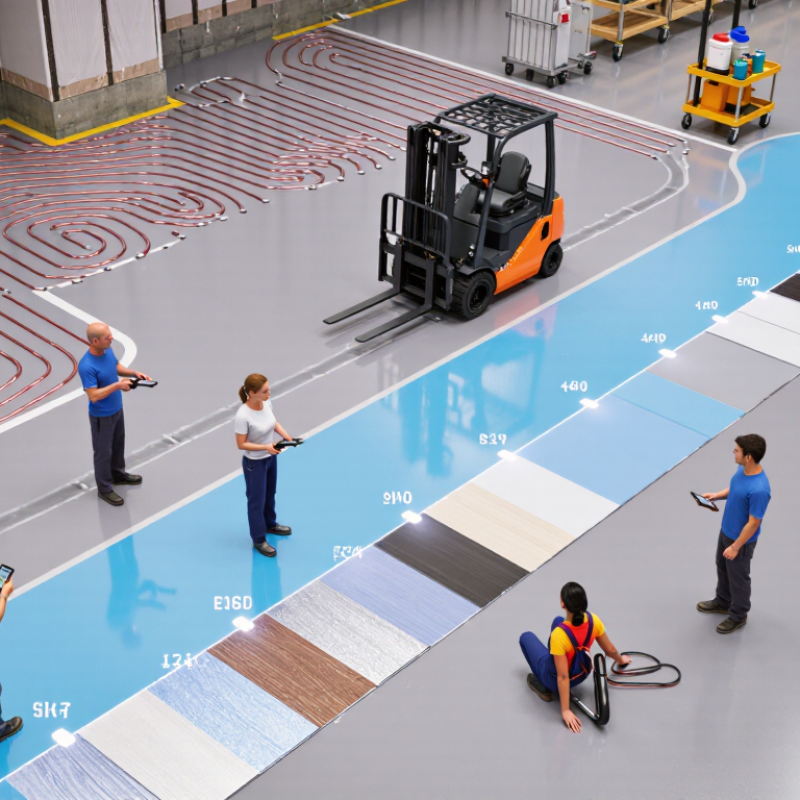
Define ESD Safe Flooring and Its Role in Global Sourcing
ESD safe flooring is a controlled surface designed to reduce static electricity and move electrical charges safely to ground. It usually uses conductive or static-dissipative materials. The floor alone is not enough. Grounding strips, approved footwear, and correct installation complete the protection system. In an electronics workspace, a worker may cross vinyl tiles while pushing a metal cart. Without control, that small movement can create a damaging discharge.
For global sourcing, the definition must become a measurable purchasing specification. Buyers should request surface resistance ranges, grounding methods, test procedures, and installation requirements. Independent test reports can improve confidence, but they should match the actual product and production batch. A laboratory result may not represent performance after adhesive failure, dust buildup, or high humidity. Small details matter.
Experienced sourcing teams also review the site conditions before comparing prices. Concrete moisture, cleaning chemicals, rolling loads, and local installation skills can change flooring performance. A heel tester should be used during acceptance checks. Records should include test locations, dates, and equipment calibration. Do not trust appearance alone. A floor can look perfect and still fail electrically. That uncomfortable possibility deserves attention. Suppliers should explain maintenance limits clearly, while buyers should leave room for retesting and corrective work. Global sourcing becomes safer when technical evidence, practical experience, and honest limitations guide the decision.
Identify Electrical, Safety, and Compliance Requirements
Choosing ESD-safe flooring starts with the electrical risk, not the surface color. IEC 61340-5-1 specifies a resistance-to-ground range of 1.0 × 10⁴ to below 1.0 × 10⁹ ohms for many personnel-grounding systems. Confirm whether your facility needs conductive or dissipative performance. Then test the complete system, including flooring, footwear, grounding points, and installation adhesives. A floor can pass in a laboratory and fail beside a humid loading door.
Safety requirements also matter. NFPA 77 emphasizes bonding, grounding, and static-control practices where electrostatic discharge could ignite flammable materials. OSHA’s workplace safety guidance highlights clean, dry, unobstructed walking surfaces. That means drainage, slip resistance, chemical exposure, and forklift traffic deserve equal attention. Request test methods, measurement conditions, aging data, and maintenance instructions from each supplier. “ESD safe” alone is too vague.
Tips: Ask for independent test reports, not only a product brochure. Check resistance at your expected humidity and temperature. Review the warranty for cleaning chemicals and rolling loads. Before global purchasing, map local electrical codes, worker-safety rules, and customs documentation. ANSI/ESD S20.20 certification can support a controlled ESD program, but it does not replace site-specific testing. One uncomfortable truth: the cheapest compliant sample may become expensive after installation. Pilot the flooring in a real production zone, record readings, and repeat them after traffic, cleaning, and seasonal changes.
Compare ESD Flooring Types, Materials, and Performance
How to Choose ESD Safe Flooring for Global Sourcing?
ESD flooring should be compared by material, electrical performance, and lifecycle evidence. Vinyl tiles are modular and easy to replace. Epoxy systems create fewer seams but require careful substrate preparation. Rubber offers strong resilience under rolling loads, though its resistance can change with humidity and contamination. Conductive concrete is durable, but installation quality often decides its final performance.
ANSI/ESD S20.20-2021 commonly evaluates the complete person-footwear-flooring system, not flooring alone. Its personnel grounding model uses a resistance limit below 3.5 × 10⁷ ohms and body voltage below 100 volts. IEC 61340-5-1 also stresses controlled resistance, grounding, and verification. These figures are useful, but they do not predict every warehouse condition. I would not trust a glossy datasheet alone.
Tips: Ask suppliers for test results under both dry and humid conditions. Check resistance after abrasion, cleaning, and caster traffic. Request samples from the same production batch. Confirm grounding points, installation records, and retesting intervals. A 2023 ESD Association technical guidance document emphasizes regular verification rather than one-time certification. Compare total cost, not only price per square meter. A cheaper floor may become expensive after failed audits or frequent repairs. Also inspect seams closely. Small gaps collect dust and can weaken practical performance. Sourcing teams should record test methods, laboratory conditions, and acceptable limits before approving samples.
How to Choose ESD Safe Flooring for Global Sourcing?
Representative electrical-resistance bands for common ESD flooring material families. Lower resistance provides stronger charge dissipation, while the final selection should also consider grounding design, wear resistance, humidity, installation quality, and verified test reports.
The resistance bands reflect widely used ESD classification thresholds: conductive flooring is generally below 10⁶ Ω, dissipative flooring is typically from 10⁶ Ω to below 10⁹ Ω, and values at or above 10⁹ Ω are generally considered insulating. Actual performance varies by construction and must be confirmed through independent testing.
Evaluate Suppliers, Certifications, Costs, and Logistics
When sourcing ESD-safe flooring globally, evaluate the supplier before comparing prices. Request factory test reports, resistance measurements, batch traceability, and installation references. ANSI/ESD S20.20 requires resistance-to-ground below 1.0 × 10⁹ ohms for many protected areas. IEC 61340-5-1 also stresses controlled grounding and verification. A supplier claiming “ESD safe” without test conditions is not enough.
Ask whether the flooring was tested after humidity changes, cleaning, and repeated foot traffic. Those details reveal practical experience. Request samples, then test them with your own footwear and grounding system. Small gaps near doorways can create large risks. Certification is useful, but it does not replace site validation. Sometimes, the paperwork looks stronger than the installation.
Cost evaluation should include adhesive, copper grounding, subfloor repair, local labor, testing, replacement stock, and import duties. A low ex-works price may become expensive after ocean freight and delays. The World Bank’s 2023 Logistics Performance Index uses a 1–5 scale to assess customs, infrastructure, shipment quality, and timeliness. Compare suppliers using your destination country’s score and port reliability. Also check packaging dimensions, pallet weight, Incoterms, lead time, and spare tiles. UNCTAD’s Review of Maritime Transport 2023 highlighted continuing volatility in shipping conditions, so delivery promises need written protection. I would not rely on one quotation. Use at least three, and leave room for mistakes.
Select, Install, and Verify the Best Flooring Solution
How to Choose ESD Safe Flooring for Global Sourcing?
Select flooring by risk, not appearance. Conductive vinyl, epoxy, and rubber systems suit different production areas. Review humidity, footwear, cleaning chemicals, traffic, and subfloor moisture before requesting quotations. A glossy surface can look precise, yet appearance proves little. IEC 61340-5-1:2024 commonly limits floor resistance to groundable points below 1.0 × 10⁹ ohms. The same standard also references a person-footwear-floor system limit below 3.5 × 10⁷ ohms. These figures should guide specifications, not replace site testing. Ask suppliers for independent test reports, aging data, and installation references from similar climates.
Installation decides whether the selected material performs. Use a qualified grounding design and document every connection. Control adhesive thickness, seams, leveling, and moisture. ANSI/ESD S20.20-2021 and ESD Association TR53 recommend periodic verification of ESD control products and systems. Test resistance after curing, before occupancy, and during routine operation. A good factory acceptance report is useful, but it cannot predict every real-world failure. Forklift dust, damaged seams, or unsuitable shoes may change the result. Recheck assumptions.
Tips: Require sample panels before global purchase. Test them with the intended footwear and cleaner. Record temperature and humidity during measurements. Re-test high-traffic zones quarterly, or more often after repairs. Keep photos, meter calibration records, and floor maps with the inspection file. If readings pass only under ideal humidity, reconsider the specification. That is a warning, not success.
How to Choose ESD Safe Flooring for Global Sourcing? - Select, Install, and Verify the Best Flooring Solution
| Flooring Solution | Typical Construction | Typical Electrical Resistance | Best-Fit Applications | Installation Requirements | Grounding Method | Verification Points | Sourcing Considerations |
|---|---|---|---|---|---|---|---|
| Conductive Vinyl Tile | Homogeneous or layered PVC tile with conductive fillers. | Commonly specified in the conductive range, typically about 1 × 10⁴ to less than 1 × 10⁶ Ω, subject to the product specification. | Electronics assembly, laboratories, cleanrooms, and areas requiring frequent cart traffic. | Dry, level, clean substrate; controlled adhesive coverage; welded or sealed joints where hygiene or moisture resistance is required. | Copper grounding strips or grid connected to the facility grounding system. | Measure point-to-point and point-to-ground resistance after installation; inspect seams, adhesive coverage, and ground continuity. | Confirm tile thickness, dimensional tolerance, slip resistance, fire classification, test method, and compliance documentation. |
| Conductive or Static-Control Sheet Vinyl | Continuous flexible PVC sheet with conductive backing or conductive layers. | Often specified from approximately 1 × 10⁴ to 1 × 10⁹ Ω, depending on whether the product is conductive or dissipative. | Cleanrooms, medical manufacturing, high-contamination-control spaces, and large uninterrupted floor areas. | Requires accurate field measurement, full-spread adhesive, heat-welded seams where specified, and protection during fit-out. | Grounding tape or conductive adhesive connected to approved ground points. | Test resistance across representative locations, including seams and perimeter zones; verify no isolated sections. | Check roll width, roll length, batch consistency, seam-welding instructions, storage temperature, and installation training. |
| ESD Epoxy or Resinous Coating | Multi-layer resin system with conductive primer, copper grid, or conductive aggregate. | Can be engineered for dissipative or conductive performance; the specified resistance range must be confirmed in the system data sheet. | Production rooms, warehouses, test areas, and locations needing seamless chemical-resistant flooring. | Concrete moisture and alkalinity testing, mechanical preparation, primer control, correct mixing, and curing within the stated conditions. | Embedded copper tape or grid connected to designated grounding points before resin layers are applied. | Verify substrate moisture, coating thickness, cure time, resistance mapping, grounding continuity, and surface uniformity. | Request the complete system specification rather than evaluating resin alone; confirm chemical, abrasion, fire, and slip-performance data. |
| ESD Rubber Tile or Sheet | Rubber flooring with conductive additives and a homogeneous or multi-layer structure. | Product-specific; commonly available in dissipative ranges and selected conductive ranges. | Heavy-duty assembly areas, workshops, laboratories, and spaces requiring resilience and comfort underfoot. | Requires a smooth, dry substrate, compatible adhesive, controlled seam treatment, and protection from contamination during installation. | Grounding strips, conductive adhesive, or an approved grounding grid according to the flooring system design. | Measure resistance after adhesive cure; check dimensional stability, seams, surface damage, and continuity to ground. | Compare abrasion resistance, indentation recovery, chemical resistance, acoustic properties, and availability of replacement material. |
| ESD Raised Access Floor | Removable panels supported on a metal pedestal and stringer system, with an ESD surface finish. | Panel and system resistance vary by surface finish, core, understructure, and grounding design. | Data centers, control rooms, electronics facilities, and spaces requiring underfloor cabling or airflow. | Requires level subfloor, accurate pedestal layout, bonding of conductive components, and controlled panel installation. | Bonded pedestals, stringers, panels, and surface finish connected to the building grounding network. | Test panel-to-panel, panel-to-understructure, and system-to-ground resistance; inspect bonding jumpers and panel fit. | Evaluate concentrated load, rolling load, fire rating, panel interchangeability, access frequency, and spare-panel logistics. |
| ESD Carpet Tile | Modular textile tile incorporating conductive fibers or a static-control backing. | Usually designed for static dissipation; exact resistance depends on the tile, backing, adhesive, and footwear system. | Offices, laboratories, control areas, and low-to-moderate industrial traffic zones where comfort and noise control matter. | Subfloor must be dry and level; use the specified conductive adhesive or installation method and maintain directional consistency. | Conductive adhesive or an approved grounding interface beneath the tile system. | Test installed floor performance with the intended footwear; inspect tile joints, contamination, and changes after cleaning. | Confirm fiber content, pile construction, cleanability, moisture sensitivity, replacement-tile consistency, and maintenance chemicals. |

