

7 Tips for Choosing High Alumina Castable?
Choosing High Alumina Castable is not a simple matter of selecting the highest alumina percentage. Furnace temperature, slag chemistry, abrasion, installation method, and drying control can change performance dramatically. A 1,500°C kiln lining may still fail early if excess water creates pores or uneven curing leaves weak zones behind. Small details matter.
The World Steel Association reported approximately 1.88 billion tonnes of crude steel production worldwide in 2024. This scale supports continuing demand for reliable refractory linings, especially in steel, cement, nonferrous metals, and waste-treatment plants. Meanwhile, Grand View Research identifies the global refractories market as a multi-billion-dollar industry, with continued growth linked to industrial production and infrastructure investment. These figures show market importance, but they do not prove that one castable fits every furnace.
Dr. G. Routschka, a recognized refractory author, emphasizes a practical principle: “Refractory selection must begin with service conditions, not product labels.” That advice deserves attention. High alumina Castable should be judged through chemistry, bulk density, strength after firing, thermal-shock resistance, and installation consistency. A product containing 80% alumina may outperform a 90% grade in one zone, yet fail in another exposed to aggressive slag. Product data sheets also need careful questioning. Laboratory results are useful, but field behavior can differ. This guide presents seven practical tips for comparing grades, checking technical evidence, and avoiding costly assumptions before installation. No perfect choice exists. The better choice matches the furnace.
Define High Alumina Castable and Its Main Applications
7 Tips for Choosing High Alumina Castable
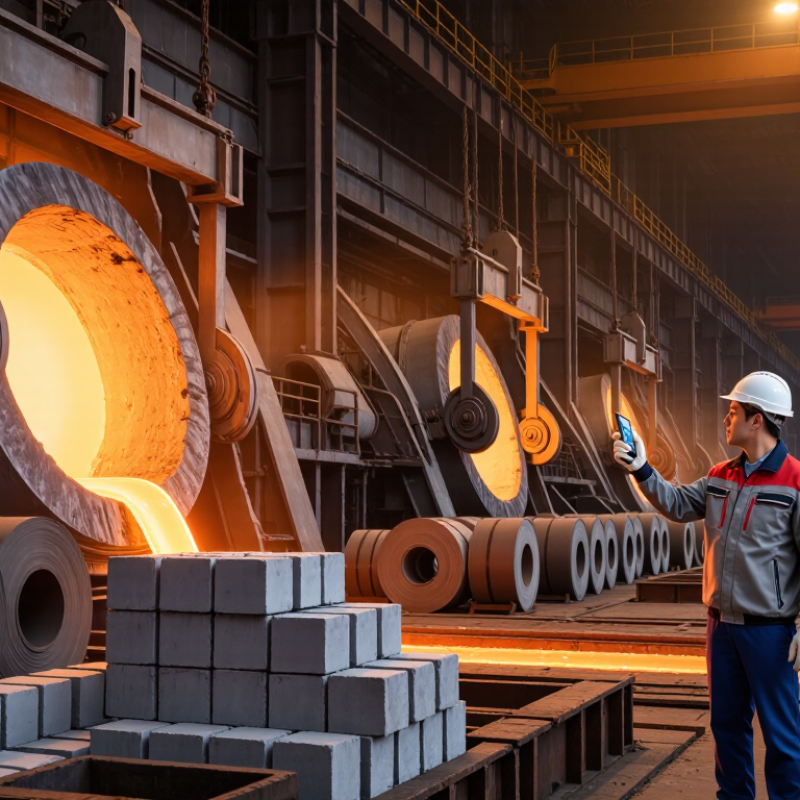
High alumina castable is a monolithic refractory containing over 45% Al2O3, commonly classified by alumina content and performance. It uses alumina-rich aggregates, cement or alternative binders, and carefully graded powders. Its main applications include steel ladles, tundish linings, cement kilns, furnace hearths, and nonferrous-metal equipment. The demand is substantial. The USGS Mineral Commodity Summaries 2024 estimated global cement production at about 4.1 billion metric tons in 2023. World Steel Association data recorded approximately 1.89 billion tonnes of crude steel that year. These industries require linings that resist heat, abrasion, chemical attack, and repeated thermal cycling.
Choose the alumina grade for the actual duty, not only the highest percentage. Check service temperature, slag chemistry, load, and abrasion level. Review cold crushing strength and permanent linear change after firing. A low-cement or ultra-low-cement formula can reduce porosity, but it demands better mixing and curing control. Particle grading matters. Poor grading may leave weak pores around large aggregates. Installation is equally important. Use clean water, accurate dosing, proper vibration, and controlled drying. Never assume a datasheet predicts field life perfectly. Site moisture and operator technique can change results.
Ask for batch traceability and independent test records. Compare abrasion loss, thermal-shock behavior, and chemical resistance under similar test conditions. Some specifications look impressive but omit test temperatures or curing periods. That deserves questions. Pilot panels can reveal cracking before a full shutdown project. A practical choice balances alumina content, installation risk, availability, and total maintenance cost.
7 Tips for Choosing High Alumina Castable? - Define High Alumina Castable and Its Main Applications
| No. | Selection Dimension | What High Alumina Castable Means | Typical Data or Reference Range | Why It Matters | Main Applications |
|---|---|---|---|---|---|
| 1 | Confirm the alumina grade | High alumina castable is a monolithic refractory concrete containing a high proportion of alumina-bearing aggregates and fine powders, usually bonded with calcium aluminate cement or another suitable binder. | Al2O3 content is commonly above 45% by mass. Commercial grades may range approximately from 45% to more than 90%, depending on the raw materials and intended service. | Higher alumina generally improves refractoriness, resistance to molten materials, and performance at elevated temperatures, but it may also increase cost and installation requirements. | Steel ladles, furnace linings, kiln components, incinerators, non-ferrous metal furnaces, and high-temperature heat-treatment equipment. |
| 2 | Match the maximum service temperature | The suitable castable must retain strength and volume stability under the actual operating temperature, including heat-up and shutdown cycles. | Many high alumina castables are designed for service temperatures of approximately 1,400–1,800°C; the exact limit depends on chemistry, porosity, cement content, and operating conditions. | Selecting only by alumina percentage can be misleading. The rated service temperature and test method should be checked together with the operating temperature. | Reheating furnaces, soaking pits, kiln linings, burner blocks, furnace roofs, and hot zones exposed to continuous or intermittent heat. |
| 3 | Evaluate chemical and slag resistance | Resistance depends on alumina content, calcium oxide level, matrix design, aggregate quality, and the chemistry of slag, ash, gases, or molten metal. | For severe chemical exposure, low-cement or ultra-low-cement formulations are often considered because they can provide a denser matrix and lower open porosity than conventional castables. | Incompatible chemistry can cause penetration, dissolution, spalling, or accelerated corrosion even when the material has adequate refractoriness. | Cement kilns, steelmaking vessels, slag lines, ash-handling zones, waste-incineration chambers, and non-ferrous smelting equipment. |
| 4 | Check physical properties | Important physical properties include bulk density, apparent porosity, cold crushing strength, permanent linear change, thermal conductivity, and abrasion resistance. | Typical bulk density may be about 2.2–3.0 g/cm3, while apparent porosity may be roughly 15–25%. Actual values vary significantly by grade and test temperature. | Higher density and lower open porosity usually support better resistance to penetration, while abrasion resistance is essential where solid particles or high-velocity gases are present. | Cyclone sections, clinker coolers, furnace hearths, transfer chutes, burner areas, and locations exposed to mechanical wear. |
| 5 | Choose the correct installation method | Castables may be installed by conventional casting, vibration casting, pumping, or dry gunning, depending on the formulation and site conditions. | Water addition must follow the technical data sheet. Excess water increases porosity and can reduce strength; insufficient water may prevent proper placement and consolidation. | Mixing time, water quality, vibration, layer thickness, ambient temperature, curing, and drying directly affect the final lining performance. | Maintenance repairs, complex-shaped linings, large furnace floors, boiler areas, kiln shells, and sections requiring fast installation. |
| 6 | Review dry-out and thermal-shock requirements | Castable linings contain mixing water that must be removed gradually before reaching high temperature. Thermal-shock resistance depends on microstructure, thickness, elastic properties, and operating cycles. | A controlled multi-stage dry-out schedule is normally required. The exact schedule should be based on castable thickness, lining design, moisture measurement, and the applicable technical data sheet. | Rapid heating can generate steam pressure and cause explosive spalling. Repeated heating and cooling can produce cracking if the grade is not suited to thermal cycling. | Intermittent furnaces, kiln doors, burner quarls, boiler linings, heat-treatment units, and equipment subject to frequent starts and stops. |
| 7 | Verify quality control and technical documentation | A reliable selection should be supported by a consistent formulation, batch traceability, test results, storage instructions, installation guidance, and service-condition recommendations. | Request data for chemical composition, particle size, bulk density, apparent porosity, strength, permanent linear change, thermal conductivity, shelf life, and recommended water addition. | Laboratory values provide a basis for comparison, but field performance also depends on design, workmanship, dry-out, operating atmosphere, and maintenance practices. | All industrial refractory installations, especially safety-critical furnace linings and high-wear or chemically aggressive zones. |